
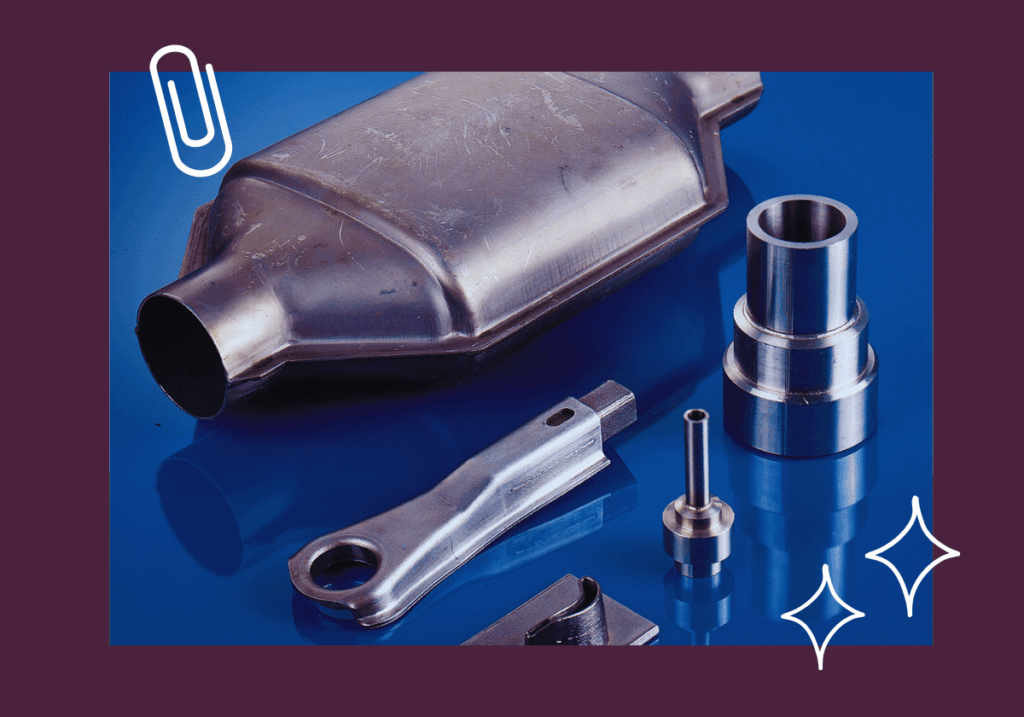
Laser welding is an industrial process renowned for its precision and ability to assemble metal parts with complex geometries. Thanks to precise control of the heat input, it can meet exacting requirements in terms of quality, tolerance and repeatability.
This process can be used to assemble a wide range of laser-welded parts, from small technical components to mechanical sub-assemblies for demanding industrial environments.
Assembly of precision industrial parts
Laser welding is particularly well suited to the assembly of precision industrial parts. It enables fine, controlled welds to be made, without altering the overall geometry of the part.
This type of assembly is frequently used for mechanical components requiring tight tolerances, sensitive functional areas or careful finishing. The small heat-affected zone limits deformation and reduces the need for reworking after welding.
Assembly of parts with complex geometries
Parts with complex shapes or hard-to-reach areas can be joined by laser welding. The precision of the beam makes it possible to target highly localized areas, even when space is at a premium.
This capability is particularly appreciated when assembling technical sub-assemblies or parts with several concentrated functional areas.
Laser welding for small and medium production runs
Laser welding is ideally suited to the assembly of parts produced in small and medium-sized batches. It offers an excellent compromise between flexibility and repeatability, without the need for heavy or special tooling.
This process is often chosen when production volumes do not justify major investment, while maintaining high standards of assembly quality.
Assembly and repair of metal parts
In addition to the manufacture of new parts, laser welding is also used for the assembly or repair of existing metal parts. It enables targeted intervention on worn or damaged areas, without damaging the entire component.
Laser welding of metal parts is particularly relevant where control of thermal distortion and precision of the repaired areas are essential criteria.
Which materials for which rooms?
Laser welding is compatible with many metals commonly used in industry, such as steel, stainless steel, copper and aluminum. However, the choice of material, the thickness of the parts and their final use influence the welding parameters to be used.
A preliminary technical analysis determines whether laser welding is the most suitable solution for assembling the parts concerned.
When is laser welding the best solution?
Industrial laser welding is particularly recommended when the parts to be joined require high precision, consistent quality and control of thermal distortion. It can be integrated into manufacturing projects as well as assembly and repair operations.
For a complete presentation of the process and its applications, please consult the page dedicated to industrial laser welding.
Evaluate the feasibility of your parts
Each industrial part has its own specific constraints linked to its geometry, material and use. A feasibility study confirms the suitability of laser welding for a given project, and points the way to the most appropriate assembly solution.