
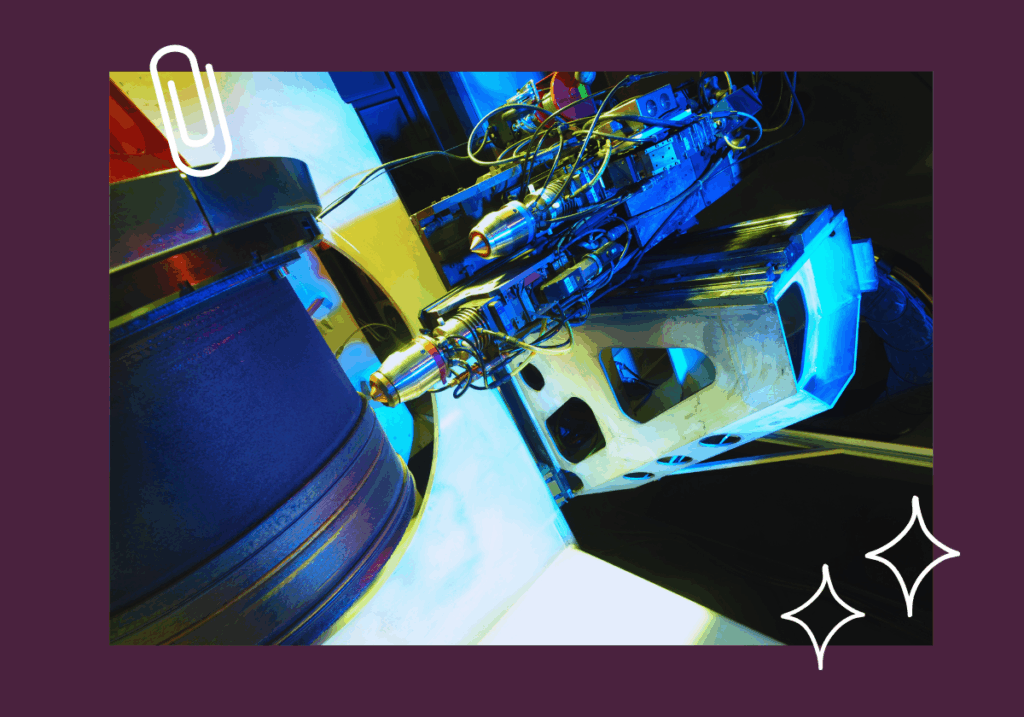
The DED (Directed Energy Deposition) process is a metal additive manufacturing technology used in industry for the manufacture, repair or modification of metal parts. Based on the addition of material by directed energy, it enables metal to be deposited with great precision directly onto an existing part or support.
This technology is particularly appreciated in industrial environments where flexibility, geometric control and mechanical performance of parts are essential criteria.
How the DED process works
DED works by combining a concentrated energy source, usually a laser, with a material input in the form of powder or wire. The material is injected directly into the molten bath created by the energy, then solidified layer by layer.
This process enables precise control of the deposition area, layer thickness and final part geometry. It can be used to manufacture a complete part, or to add material to an existing component.
The benefits of DED for industry
DED offers several major advantages for industrial applications. In particular, it enables us to work on large parts, without being limited by print volume. The flexibility of the process also enables localized repairs or targeted geometric modifications.
Controlling the heat input limits deformation and ensures mechanical properties tailored to industrial requirements. DED can be easily integrated into existing production lines and combined with machining operations to achieve precise tolerances.
DED industrial applications
DED is used in many industrial contexts. It is particularly well-suited to the repair of worn or damaged metal parts, allowing only the necessary areas to be reloaded. This approach extends component life and reduces replacement costs.
The technology is also used to manufacture complex metal parts or functional prototypes, as well as to add functionality to existing parts. In some cases, DED is used to produce customized parts or high value-added small series.
DED and metal additive manufacturing
DED is an integral part of metal additive manufacturing technologies. It stands out for its ability to work directly on existing parts, unlike other additive processes which are more oriented towards the manufacture of complete parts.
This makes DED additive manufacturing particularly relevant for industrial applications requiring robustness, adaptability and precise control of the deposited material.
When should you choose DED for an industrial project?
DED is recommended when the project involves large parts, targeted repairs or geometric modifications to existing components. It is also suitable for projects requiring strong customization or rapid adaptation to specific technical constraints.
For an overview of related technologies, please visit the page dedicated to metal additive manufacturing.
Assessing the feasibility of a DED project
Each industrial project has its own constraints linked to materials, geometries and mechanical requirements. A feasibility study is carried out to determine whether the DED process is the most suitable, and to optimize the deposition parameters to guarantee a result that meets expectations.