
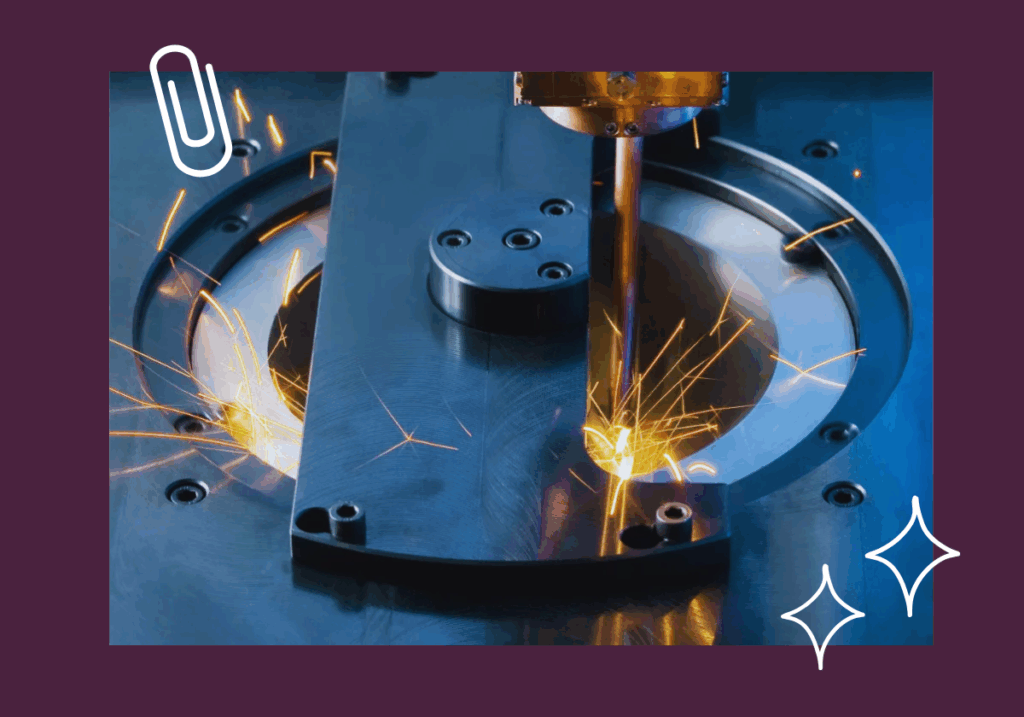
Industrial laser welding is an assembly process increasingly used in industry for its precision, speed and the quality of the welds obtained. This technology is based on the use of a concentrated laser beam to locally melt the material and weld metal parts, with great control over the weld seam.
Used for the production of new parts as well as for repairs and complex assemblies, laser welding has become a benchmark solution in many industrial sectors.
Definition of industrial laser welding
Would you like to find out more about industrial laser welding?
Industrial laser welding is a welding process that uses laser energy to join metal parts. Unlike traditional welding methods, the heat source is highly concentrated, enabling the material to be heated and melted over a very precise area.
This process is particularly well suited to industrial environments requiring high assembly precision, repeatability and rigorous control of thermal distortion.
How does laser welding work?
The principle of laser welding is based on the projection of a high-intensity laser beam onto the area to be joined. The laser’s light energy is converted into heat on contact with the material, causing the metal to melt locally.
The process generally takes place in several stages. The laser beam is focused precisely on the weld zone, causing the material to heat up rapidly. The edges of the parts to be joined then melt, and solidify rapidly after the laser has passed over them.
This concentration of energy produces fine, even and clean welds, with a much reduced heat-affected zone compared to traditional welding processes.
Why use laser welding in industry?
High precision
The laser beam enables very precise control of the welded area, which is essential for technical or small parts requiring tight tolerances.
Low thermal deformation
Limited thermal diffusion greatly reduces part deformation, which in turn reduces post-weld rework and improves final assembly quality.
Excellent repeatability
Laser welding is particularly well suited to industrial production processes requiring consistent quality from one part to the next, especially in repetitive production runs.
High execution speed
The speed of the process means that production cycles can be optimized, particularly for small and medium-sized production runs.
What types of parts and materials can be welded?
Industrial laser welding is used to assemble a wide range of metal parts, such as precision industrial parts, complex mechanical components or elements requiring a meticulous finish.
It is particularly suited to small and medium-sized production runs, as well as to parts with complex geometries. This process is compatible with many metals used in industry, such as steel, stainless steel, copper or aluminum, provided that the welding parameters are correctly adapted.
The difference between laser welding and other welding processes
Compared with traditional processes such as TIG or MIG welding, laser welding features a much smaller heating zone and better control of the weld bead.
It offers superior precision, particularly on complex or small parts, and is easily integrated into automated industrial processes. TIG and MIG processes are still suitable for many applications, but laser welding is preferred when precision, visual quality or deformation limitation are decisive criteria.
When is laser welding particularly suitable?
Industrial laser welding is particularly relevant for assembling high-precision parts, repairing metal parts without major deformation, welding complex or hard-to-reach components, and for industrial production requiring consistent quality.
It is also used to complement certain additive manufacturing or material deposition processes, where control of heat input and precision is essential.
Call in an industrial laser welding specialist
Every industrial project has its own specific technical constraints, whether in terms of part type, material, tolerances, production volumes or quality requirements. Calling on a specialist in industrial laser welding enables us to accurately assess the project’s feasibility and define the most suitable process.
An upstream technical exchange often enables us to optimize the choice of technology, anticipate manufacturing constraints and ensure a result in line with industrial requirements.